Category: Uncategorized

KARLOV’S ACCORDION (BULGARIA)
Typical Bulgarian folk instruments like the kaval, gadulka, and gajda were joined by the accordion in the early 20th century. Karlov, born in 1924 in Sofia to a Bulgarian-Roma family, came to be considered the father of Bulgarian accordion style. It was probably helpful that his own father, Karlo Aliev (check him out on Excavated Shellac), was a highly-regarded musician and director of Krenjaska, an ensemble that gained fame playing on Radio Sofia in the 1930s. Boris took over as director of the group when his father died in 1944 and soon became a celebrated musician. His true love was for folk music, and he applied his amazing technique and musicianship to styles from many different regions, although his roots were in western Bulgaria. Here he plays a dance tune in 11/8 from northern Bulgaria called “Gankino Horo.” The label Radioprom was formed by the nationalizing of small local labels in the late 1940s and eventually changed into the Balkanton label.
Boris Karlov died in 1964.

ARKANSAS BILL GREEN (TEXAS)

“They have down in Arkansas what they call the Bill Green, and that’s a square dance.
All the partners to their places, straighten up their faces for a Bill Green.”

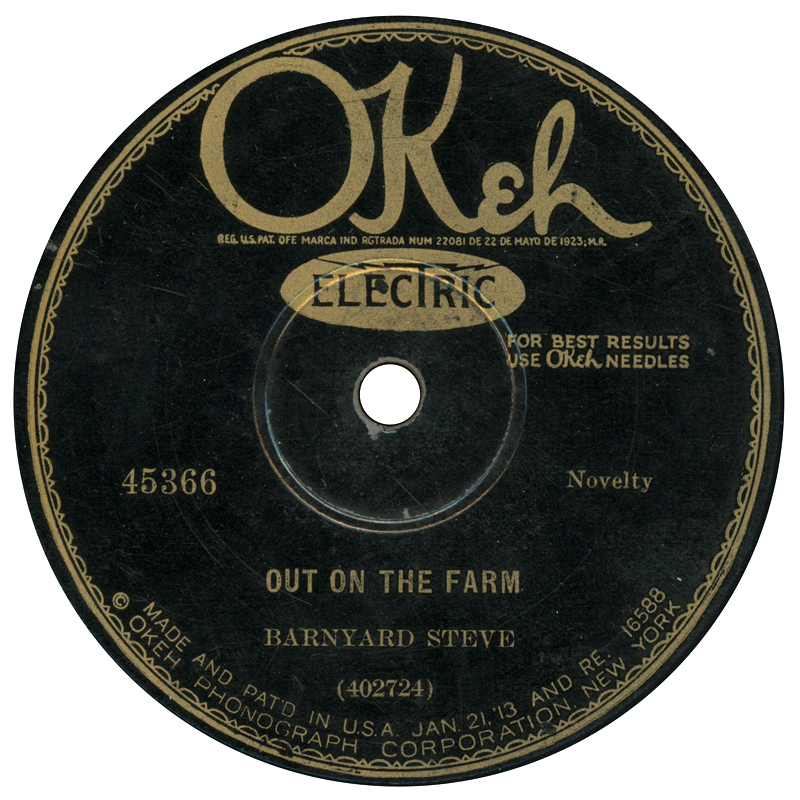
I’ve been listening to old time country 78s (“Hillbilly”) for nearly 20 years, but I have bothered to collect only a few because so many of the recordings have been reissued on cd. This has always been a favorite record of mine, and as far as I know, it has never been reissued. Unfortunately, it’s not in great condition and I’m always on the lookout for a cleaner copy, but this is the only one I’ve ever seen! Recorded 83 years and 2 days ago in Dallas, on June 26, 1929. I think it’s the finest example of American old-time jaw harp playing on 78. I have no idea who Barnyard Steve really was, but I love how you can hear him imitating the dance rhythm of old-time fiddle bowing by using his breathing, rather than the striking of the harp’s tongue (or “twanger” as some old timers call it). He even calls out square dance figures with the harp still clearly set against his teeth.  It’s a shame that Barnyard Steve only made this single record. However, the flip side is a fantastic series of barnyard animal impressions, some of which are almost chilling.


**UPDATE**

I was contacted by Mr. Steve Austin, Barnyard Steve’s grandson, who provided me with the following details. Steve Edward Austin was born in Riddleville, Texas on May 29, 1890. He performed on the Orpheum Vaudeville circuit as Barnyard Steve, other times as Uncle Hiram and his Animals. Later, he became a regular performer on WFAA-AM in Dallas. He also toured high schools as a ventriloquist and even supplied animal voices for Walt Disney. According to his grandson, Barnyard Steve played no instruments other than the jaw harp, and was not, to his knowledge, a real square dance caller.
He died in Dallas, Texas on May 12, 1955.


Thanks to Steve Austin for supplying these details and photograph! In honor of this new information I’m adding the B-side to this post.

TAR (ARMENIA)

Tar is the Persian word for “string”, and is the root of many instrument names (guitar, sitar, dotar, etc.) The instrument called tar is used widely throughout Iran, Armenia, Azerbaijan, Georgia and Afghanistan. It seems to have originated in the region of southwestern Azerbaijan and eastern Armenia. Considered the “sultan of instruments” by Persians, it holds a prime position in radif, Persian classical music. During the 19th Century, a variation of the Persian tar was developed in Azerbaijan with a slightly different shape and additional strings.

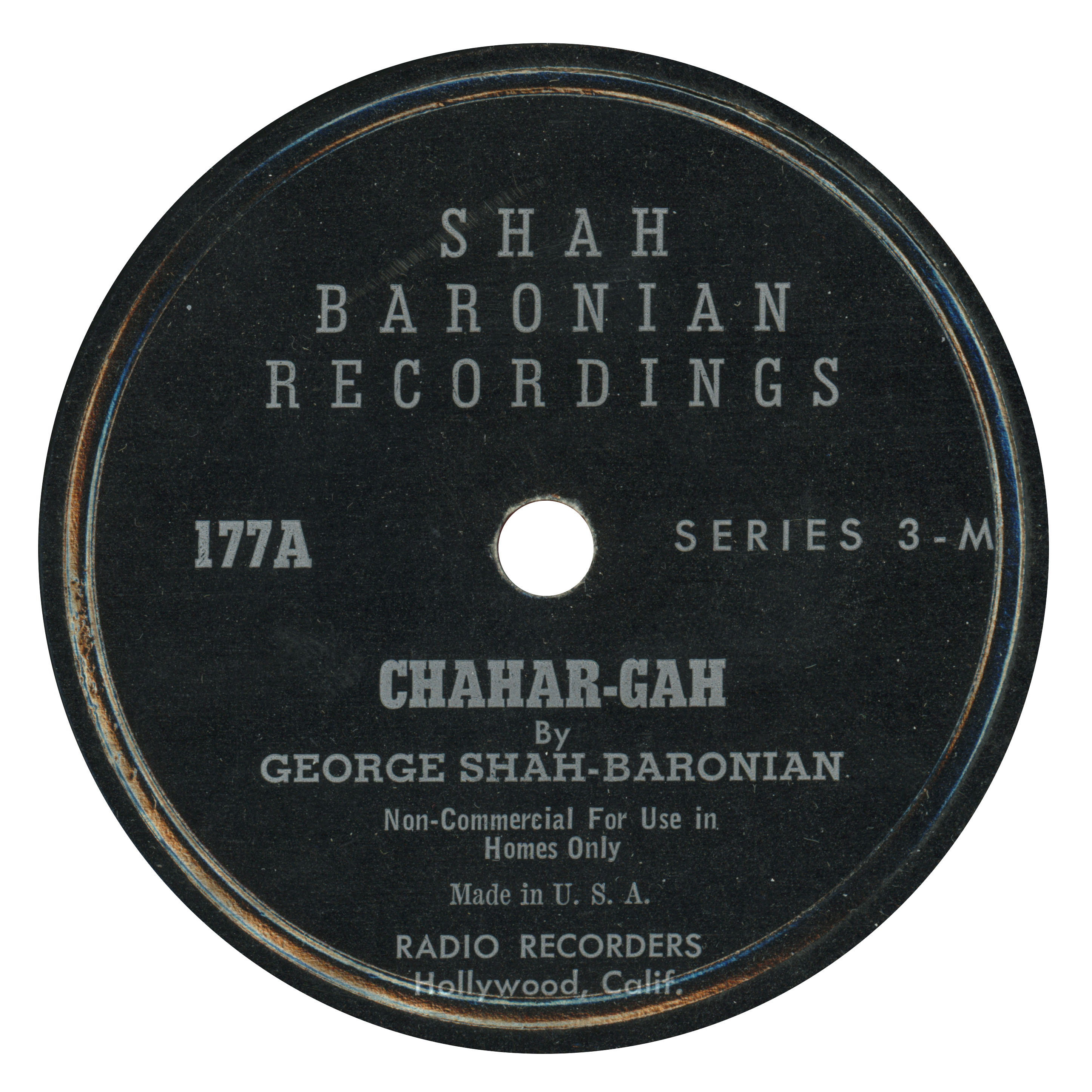
George Shah-Baronian was an Iranian of Armenian origin. During the 1920s, he recorded in New York for the Pharos and Sohag labels. At some point, he seems to have relocated to Los Angeles where he performed and recorded this record at the famous  “Radio Recorders” studio in Hollywood, where many greats recorded, including Elvis. If anyone can fill in the details on Shah Baronian please leave a comment (paging Ian Nagoski!).

Unfortunately, this record has a small chip at the edge, so we miss the introduction to this otherwise excellent tar solo.